Beckham Law Spain for Americans (2026): 24% Flat Tax
The Beckham Law lets qualifying newcomers pay a flat 24% on Spanish employment income for six years instead of the progressive scale. Here is who qualifies in 2026, how it pairs with the Digital Nomad Visa, and the US tax reality most guides leave out.
Beckham Law in 60 Seconds
Formally the regimen especial para trabajadores desplazados a territorio espanol (article 93 of the IRPF law), the Beckham Law lets someone who moves to Spain be taxed broadly like a non-resident on their Spanish-source income. In practice that means a flat 24% on employment income up to 600,000 euros per year, rather than the progressive resident scale that climbs into the mid-40s percent. For a high-earning American professional relocating to Spain, the difference can be substantial. The regime is an election, not automatic, and the window to elect is short.
History and the 2023 to 2026 Updates (Ley Startups Expansion)

The regime was introduced in 2005 and took its nickname from footballer David Beckham, an early high-profile user. For years it was aimed mainly at employees posted to Spain by a company. The 2023 Startups Law (Ley de Startups, Ley 28/2022) significantly widened it.
- Shorter prior-residence bar: the requirement of not having been a Spanish tax resident dropped from ten years to five years before the move.
- New categories: the reform extended access to remote workers and Digital Nomad Visa holders, entrepreneurs pursuing an innovative activity, and certain highly qualified professionals, not only classic posted employees.
- Family inclusion: under conditions, a spouse and children can also elect the regime, which was not previously available.
As of 2026 these expanded rules remain in force. Because tax rules change with each budget cycle, verify current thresholds and categories against official sources such as the BOE (Boletin Oficial del Estado) and the Agencia Tributaria before relying on them.
Who Qualifies: Employees, Entrepreneurs, Digital Nomads and Athletes
Eligibility rests on a few core conditions and then on fitting an accepted category. The baseline conditions are that you become a Spanish tax resident because of the move, that you were not a Spanish tax resident in the prior five years, and that your move has a qualifying trigger.
- Employees: people who relocate under an employment contract with a Spanish or foreign employer, the classic posted-worker case.
- Digital nomads and remote workers: those working remotely for non-Spanish employers, including holders of the Digital Nomad Visa.
- Entrepreneurs: people moving to carry out an economic activity classified as entrepreneurial or innovative under the Startups Law criteria.
- Highly qualified professionals and administrators: including certain company directors and specialists, and professionals providing services to startups.
- Athletes and performers: the category that gave the regime its nickname, still available subject to the general conditions.
The 24% Flat Rate: What Income It Covers and What It Does Not
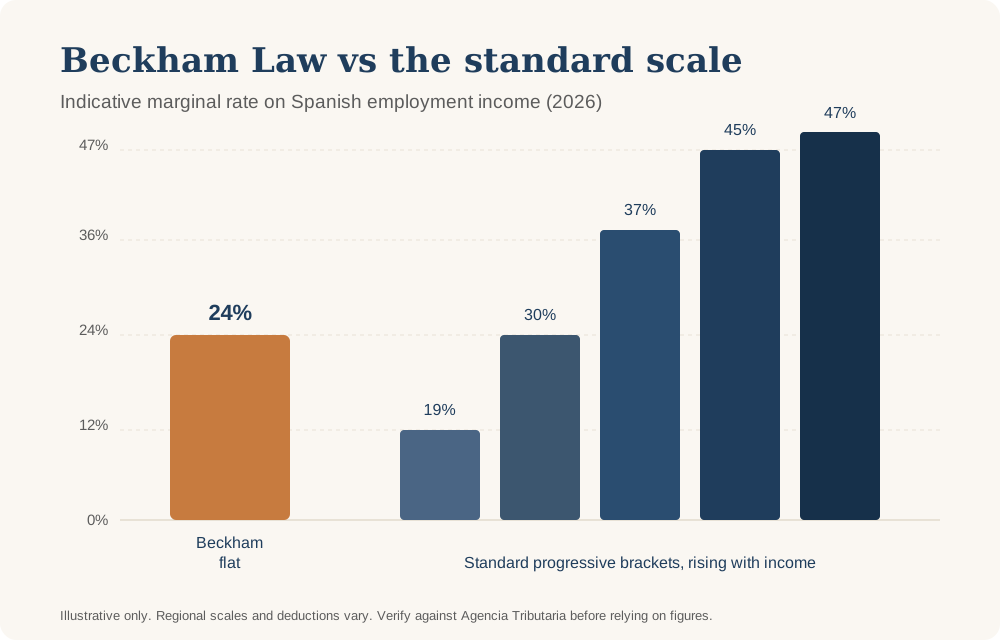
The headline benefit is a flat 24% on Spanish-source employment income up to 600,000 euros per year, with 47% on the portion above that. It replaces the progressive resident scale, which reaches similar top rates at far lower income. The regime also broadly excludes most foreign-source income from Spanish tax, with important exceptions, because you are taxed closer to a non-resident.
| Beckham regime | Standard resident regime | |
|---|---|---|
| Spanish employment income | Flat 24% up to 600,000 EUR, 47% above | Progressive scale into the mid-40s percent |
| Most foreign-source income | Generally outside Spanish tax, with exceptions | Taxed on worldwide income |
| Personal deductions and allowances | Largely unavailable | Available |
| Wealth and reporting | Narrower scope in many cases | Full worldwide reporting (Modelo 720 and others) |
The trade is that the regime removes many deductions and allowances a standard resident enjoys. For someone with high Spanish salary and little else, the flat rate usually wins. For someone with large deductions or mostly passive income, the standard regime can be cheaper. This is why modeling both is essential before electing. Confirm the current brackets and the treatment of your specific income against the Agencia Tributaria.
How Long the Beckham Regime Lasts
The regime applies for the tax year in which you become a Spanish tax resident plus the following five tax years. That is six tax years in total. At the end of the period you move to the ordinary resident regime and are taxed on worldwide income under the progressive scale, unless the law has changed by then. You cannot renew the regime; it is a one-time window tied to a single relocation.
Because the clock is measured in tax years rather than calendar months from arrival, the timing of your move within the year affects how much of the first year the regime covers. Planning the arrival date is part of getting full value from the six years.
Beckham Law and the Digital Nomad Visa: The Overlap Opportunity
The pairing of the Digital Nomad Visa and the Beckham Law is the single most attractive combination for many American professionals. The 2023 Startups Law created both, and it expanded the Beckham regime specifically so that remote workers and Digital Nomad Visa holders can elect it. A high-earning remote worker can secure the right to live in Spain through the visa and then cap Spanish employment tax at the flat 24% for six years.
The two are separate applications with separate deadlines. Approval of the visa does not elect the tax regime; you must file the Beckham election within its own window after your residence and social security steps. Sequencing them correctly is where the value is won or lost. Our Digital Nomad Visa guide covers the residence side, and this page covers the tax election that follows.
Application Deadlines and How Not to Miss Them
The election is made on Modelo 149. The general rule is that you must file within six months of the start of your activity, typically measured from your registration with Spanish social security or the equivalent trigger for your category. Miss that window and the regime is normally lost for that relocation, with no second chance.
- Confirm eligibility: Check that you have not been a Spanish tax resident in the prior five years and that your move fits an accepted trigger such as an employment contract or a Digital Nomad Visa.
- Establish residence and social security: Complete your residence step and register with Spanish social security or start your activity, which starts the clock on the election deadline.
- File the election (Modelo 149): Submit the Beckham regime election within the six-month window, with the supporting documents for your category.
- File annual returns under the regime: Report Spanish-source income each year on the non-resident-style return (Modelo 151) at the flat rate for the duration of the regime.
The recurring failure mode is treating the tax election as an afterthought to the visa. By the time some newcomers ask about it, the six-month clock has already run. We calendar the deadline from the moment your residence step completes, so the election is filed with room to spare. Confirm the exact deadline for your category against the Agencia Tributaria, because the trigger date differs between employees, autonomos, and administrators.
Model Your Savings With the Beckham Calculator
Whether the regime helps depends on your numbers: your Spanish salary, your other income, and your US position. Before committing, model the flat 24% against the standard progressive regime for your actual figures rather than a generic example.
| Why it matters | |
|---|---|
| Spanish employment income | Sets the base for the flat 24% and the 600,000 EUR ceiling |
| Other and foreign income | Determines whether the standard regime would tax more |
| Deductions you would lose | The regime removes many allowances, which can offset the saving |
| US position | A lower Spanish rate can reduce foreign tax credits on Form 1040 |
US Tax Interaction: The IRS Does Not Care About Your Spanish Rate
This is the point most Beckham guides skip, and it is the one that matters most for Americans. The United States taxes its citizens on worldwide income no matter where they live or which foreign regime they elect. Electing the Beckham Law does not reduce, defer, or change your US filing obligations. You keep filing Form 1040, and you may owe FBAR (FinCEN 114) and FATCA (Form 8938) reports.
The subtle trap is the foreign tax credit. US foreign tax credits are based on the foreign tax you actually pay, not on a rate you could have paid. A lower Spanish rate under Beckham means less Spanish tax to credit against your US tax, which can leave a larger residual US bill. In some profiles the Spanish saving is partly clawed back by the IRS. The only way to know your true combined position is to model Spain and the US together. See our US-Spain double taxation guide for how the two systems interact. This is general information, not tax advice; verify your case against IRS Publication 54 and a qualified US tax adviser.
When Beckham Law Is Not the Right Choice
The regime is a planning tool, not a default. It can be the wrong choice when:
- Most of your income is passive or foreign: the flat rate mainly benefits Spanish employment income, and you may lose valuable deductions for little gain.
- You have large personal deductions: the regime removes many allowances that would reduce a standard resident bill.
- The US credit math turns against you: a lower Spanish rate can shrink your foreign tax credits and raise your net US tax, erasing part of the saving.
- Your income is modest: at lower Spanish salaries the progressive scale can already sit below 24%, so the flat rate costs more.
Because the election is irreversible for the period and the deadline is tight, the decision should follow a side-by-side model, not a rule of thumb.
Our Beckham Law Application Service
As a Valencia colegiada gestora administrativa, Elena assesses whether the regime actually saves you money against the standard scale and your US position, then, if it does, files the election correctly and on time. That covers checking the five-year prior-residence condition, fixing the trigger date for your category, preparing and filing Modelo 149 within the window, and handling the annual Modelo 151 returns under the regime. The aim is a decision backed by numbers and a filing that does not miss the deadline.
If you are still arranging residence, the Digital Nomad Visa is the most common route to pair with Beckham, and the NIE, TIE and empadronamiento steps set up the residence and registration the tax election depends on.
Frequently Asked Questions
Talk to Elena
Message us on WhatsApp for a real plan
Should you elect the Beckham Law?
Message Elena on WhatsApp and leave with a side-by-side tax model, a US interaction check, and a filing timeline that meets the deadline.